
Minimum Viable Product, Proof of Concept or Prototype: Which One Do You Need?
You have a software product idea. You’ve talked to potential users, found a problem worth solving, and maybe even discussed features with a development company.
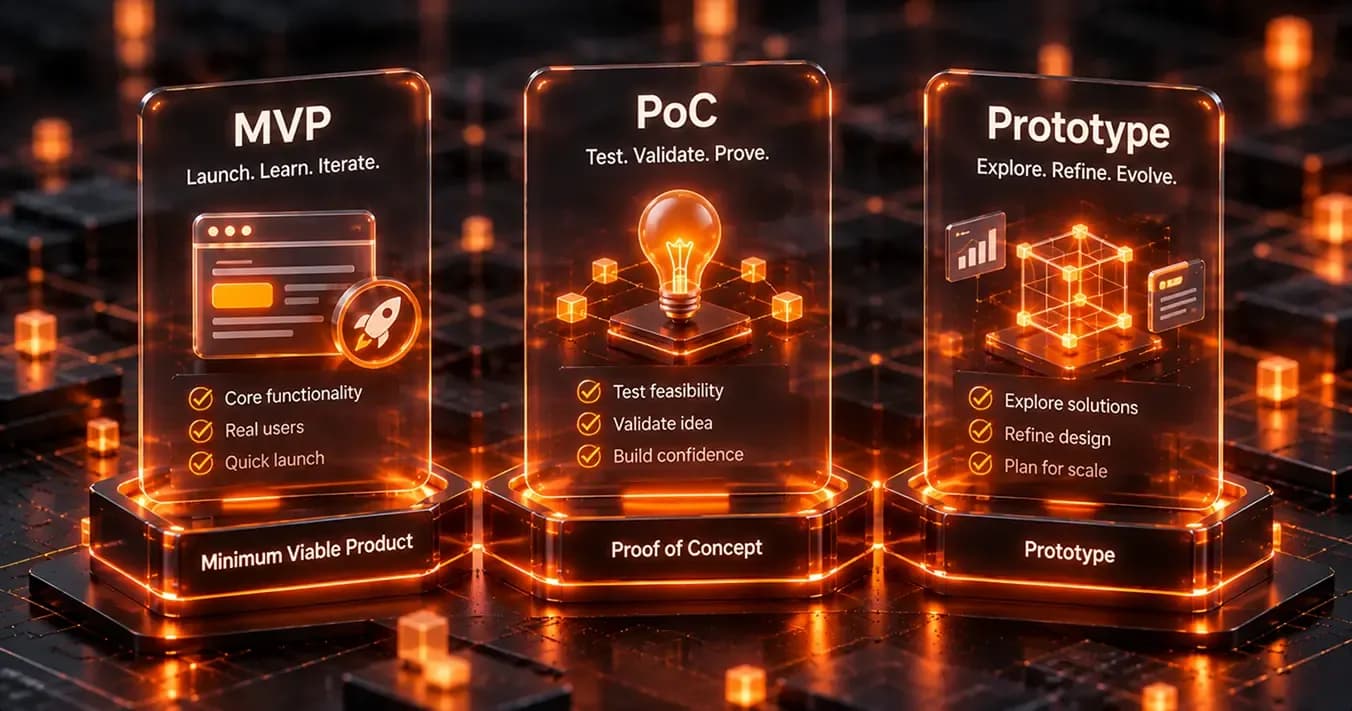
Now comes the first investment decision: should you commission a Proof of Concept (PoC), a prototype, or a Minimum Viable Product (MVP)?
People often use these terms interchangeably, but they mean different things.
→ A PoC checks if something can work.
→ A prototype shows how the product might look and work.
→ An MVP gives real customers a usable version to see if there’s demand.
Choosing the wrong option can cost more than your initial development budget.
You might pay for a prototype when you really need to test if the technology works, or build a full MVP when a simple technical test would have answered your main question.
This guide explains what each option offers, how much effort each usually takes, and how to pick the right starting point for your software idea.
The right starting point for software development isn't always a complete product. It's the smallest investment that answers your biggest unanswered question.
MVP vs Proof of Concept vs Prototype: A Quick Answer
1. Go with a Proof of Concept if you need to check if the technology works. 2. Choose a prototype to test the product experience. 3. Pick a Minimum Viable Product if you want to try out a working solution with real users.
| Development option | What it answers | Primary purpose | Typical audience |
|---|---|---|---|
| Proof of Concept | Can we build this? | Test technical feasibility | Founders and technical teams |
| Prototype | How should this work? | Test design and user experience | Founders, stakeholders and test users |
| MVP | Will customers use this? | Validate the product with real users | Early customers |
Important: You don’t have to go through all three stages for every software project. Only invest in the work that helps you answer the questions holding you back right now.
Which development approach should you choose to test whether an AI model can accurately extract information from documents?
What Is a Proof of Concept?

A Proof of Concept (PoC) is a small technical experiment designed to establish whether a specific idea, feature or technology can work.
It addresses a technical uncertainty before you invest in building the complete application.
For example, imagine you want to develop a healthcare application that uses AI to extract information from medical documents.
Before developing the application, you may need to establish whether the chosen AI model can extract the required information accurately enough.
A PoC could test the model against a sample set of documents and measure its output quality.
It doesn't need a polished interface, complete user accounts, or a customer-ready workflow. Its purpose is to produce technical evidence.
When Do You Need a PoC?
Consider a PoC when:
- Your product depends on an untested technology or technical integration.
- You are unsure whether a required API or external system can support the functionality.
- You need to test an AI model, algorithm or data-processing method.
- A technical limitation could make the proposed product unviable.
Typical timeline: 1–3 weeks for a narrowly defined technical experiment.
Relative cost: Low. It usually takes the least development effort since it only tests one technical question instead of building a full application.
Actual effort depends on the complexity of the technology, the availability of test data, and access to external systems.
Expected deliverable: A working technical demo, test results, any found limitations, and a recommendation on whether to move forward.
A successful PoC doesn’t show that customers want the product. It just proves that the technical approach works under the tested conditions.
What Is a Prototype?
A prototype is a visual or interactive representation of how your proposed product will look and function.
It lets you review the user experience before you commit to full software development.
For example, if you are planning a food delivery application, a prototype could demonstrate how users browse restaurants, select items, add them to a cart, and proceed to checkout.
Users can interact with the screens and provide feedback on navigation, layout, and the overall experience.
A prototype may be:
- Low-fidelity: Basic sketches or wireframes showing the structure of screens.
- High-fidelity: Detailed designs that resemble the final application.
- Interactive: Clickable screens that simulate user journeys and interactions.
A prototype doesn’t need a working backend, database, or real business logic. Its main job is to show and test the experience.
When Do You Need a Prototype?
Consider a prototype when:
- You know what problem the product should solve but need to define the user journey.
- You are unsure whether users will understand the proposed interface.
- Stakeholders need to review the product experience before development.
- You want early feedback on navigation, screen layouts and functionality.
- You need to communicate the product concept to potential partners or investors.
Typical timeline: 1–3 weeks for a focused interactive prototype.
Relative cost: Low to medium. The effort depends on how many screens you need, how complex the design is, and how interactive it should be.
Expected deliverable: Wireframes, designed screens or a clickable prototype that stakeholders and test users can review.
A prototype can help identify usability problems before development begins. However, even a great prototype doesn’t prove the software works or that customers will pay for it.
What Is a Minimum Viable Product?
A Minimum Viable Product (MVP) is the smallest functional version of your software product that delivers its core value to real users.
Unlike a PoC or prototype, an MVP is actual working software. It supports a defined user journey and contains the essential functionality required to test the product in a real-world environment.
Let’s consider the food delivery application again.
Instead of developing restaurant discovery, loyalty programmes, advanced recommendations, multiple payment options and promotional campaigns, the first release could focus on:
- User registration and login.
- Restaurant listings.
- Menu browsing.
- Cart and checkout.
- Order confirmation.
- Basic order management.
This is enough to see if customers will use the app to place orders and if the business can handle them.
When Do You Need an MVP?
Consider minimum viable product development when:
- You have identified a specific customer problem.
- You have a reasonably clear understanding of the core user journey.
- You need feedback from actual customers rather than internal demonstrations.
- You want to test willingness to use or pay for the product.
- You are ready to establish the foundation for future product development.
Typical timeline: 6–12 weeks for a focused software MVP with a manageable feature set and limited integrations.
Relative cost: High compared with a PoC or prototype because it involves actual software development, testing, deployment and operational requirements.
Expected deliverable: A functional application that early users can access, use and provide feedback on.
An MVP should have enough technical quality to support its users. ‘Minimum’ means the scope is limited, not the reliability or quality.
Know What to Build Before You Commit Your Budget
Get clarity on what your product needs at this stage. We will you identify what to validate, define the right scope, and plan your next development step.
PoC vs Prototype vs MVP: Cost and Timeline Comparison

The differences are easier to see when you compare how much development work each one takes.
| Factor | Proof of Concept | Prototype | Minimum Viable Product |
|---|---|---|---|
| Primary objective | Technical feasibility | User experience and design | Market and product validation |
| Development effort | Limited technical experiment | Design and interaction work | End-to-end software development |
| Typical timeline | 1–3 weeks | 1–3 weeks | 6–12 weeks |
| Relative cost | Low | Low to medium | High |
| Working software | Limited technical functionality | Usually simulated interactions | Functional application |
| Intended audience | Internal technical stakeholders | Stakeholders and selected test users | Real early customers |
| Main deliverable | Technical evidence | Interactive product representation | Usable software product |
| What comes next | Technical planning or development | Refinement or development | Iteration and product expansion |
Note: These are just planning estimates for focused projects, not fixed industry standards or quotes. Actual timelines and costs depend on things like scope, technical complexity, integrations, data readiness, design needs, and team size. Sometimes, a complex PoC can cost more than a simple prototype.
Why Does an MVP Cost More?
A PoC may require a developer to test one technical capability. A prototype may require a designer to create and connect a set of screens.
An MVP involves a broader development effort. Depending on the product, it may require:
- Frontend and backend development.
- Database architecture.
- User authentication and access controls.
- API and third-party integrations.
- Application testing and debugging.
- Deployment and basic monitoring.
That extra work is what makes an MVP ready for real users. But if you build one before checking key technical or design assumptions, you might end up having to redo work later.
Software Development Readiness Checklist
0 of 8 complete- Core business problem clearly identified
- Target users and their requirements understood
- Technical feasibility evaluated
- Essential user journey mapped
- Development features prioritised
- Development scope and budget defined
- Expected deliverables and acceptance criteria agreed
- Next development stage planned
Need help with your product development plan?
Talk To Our TeamWhich One Should You Build? A Decision Tree
The simplest way to decide is to figure out the biggest unanswered question about your product.
<escape>
START: What is the biggest uncertainty about your product?
├── Is the technology or integration feasible?
│ └── YES → Build a Proof of Concept
│ Timeline: 1–3 weeks | Relative cost: Low
│
└── NO
├── Is the user experience or product flow unclear?
│ └── YES → Build a Prototype
│ Timeline: 1–3 weeks | Relative cost: Low–Medium
│
└── NO → Do you need to test the product with real customers?
└── YES → Build an MVP
Timeline: 6–12 weeks | Relative cost: High
If you already know the answers to the technical and design questions, you might not need a separate PoC or prototype. You can go straight to building your MVP.
Three Examples to Help You Decide
Example 1: An AI-powered document processing application
Your biggest concern is whether AI can extract information accurately from different document formats.
Start with a PoC. Test the model using representative documents and establish its accuracy and limitations before building the application.
Example 2: A new marketplace application
You understand the marketplace concept but are unsure how buyers and sellers should navigate the platform.
Start with an interactive prototype. Test the registration, listing, search, and enquiry journeys with potential users before committing to development.
Example 3: A subscription-based business management platform
You have identified a target audience, understand its problem, and have validated the essential workflow. You now need to establish whether customers will use and pay for the solution.
Build an MVP with the essential subscription, account, and core business functionality. Release it to a controlled group of early customers and evaluate actual usage.
How to Avoid Paying Twice

The biggest mistake is paying for development work without first agreeing on what question it should answer.
A founder might pay for a prototype thinking it will be working software, or approve an MVP and later find out its main technology can’t do what’s needed.
Before you sign a development agreement, make sure you’ve covered these five points:
- Define the uncertainty: What specific question must this engagement answer?
- Agree on the scope: Which features, tests or interactions are included, and which are excluded?
- Specify the deliverable: Will you receive test results, design files, clickable screens or deployed software?
- Set acceptance criteria: How will you determine whether the work has achieved its purpose?
- Plan the next decision: What will you do with the findings, and what additional investment might follow?
Be sure to clarify who owns the source code, design files, technical documents, and any reusable assets. These details are important when you move from an early test to full development.
The right development partner should help you identify what you need before recommending what to build.
Start With the Right Development Investment
You don’t have to pay for a full product just to answer every question about your idea. Instead, find out what’s still unclear and invest in the right development work to solve it.
Olio NeXus helps founders turn their ideas into technical validation, interactive prototypes, and working software by focusing on discovery and responsible development.
Share This Blog:



Author
Vanita Gaware

Product Manager, Olio Nexus
Vanita Gaware, Product Manager at Olio NeXus, champions the idea that every great product starts with asking the right questions. She thrives where business goals, user journeys, and technology meet, turning complexity into clarity. She writes about AI, software, product strategy, and the choices that turn technology into real-world value.
Not Sure What Your Product Needs First?
Let’s assess your idea, identify the biggest development risks and determine the most practical starting point for your budget.
Frequently Asked Questions
Start with the one that addresses your biggest uncertainty. Use a PoC to test technical feasibility, a prototype to test design and usability, and an MVP to validate a working product with real customers. You do not necessarily need all three.
Related Articles
Subscribe To Our Insight
Get the latest AI, technology, and business insights from Olio Nexus.