Loading service0%
Build a version of your product to show whether the full build is worth it.
We scope, design, and develop minimum viable product (MVP) builds for founders, product teams, and businesses that need real user validation before investing fully. This includes web, mobile, SaaS, AI-powered MVP development, API-first, and AI-powered products.
In 15-45 days, you'll have a working product in users' hands, validated assumptions about the market's needs, and a clear, evidence-based brief for your AI product or full build.
A working product in users' hands.
Validated assumptions about the market's needs.
The idea is clear. The market opportunity is real. However, committing to a full software build before validating the core assumption can feel out of sequence: too much time, too much budget, and too much risk for something untested with real users.
This instinct is correct. Many failed builds are based on conviction rather than validated user behavior. When assumptions aren't tested, change becomes costly after launch.
You've seen quick MVPs become liabilities: code that can't scale and architecture needing replacement before the full build. Upfront time saved leads to more work later.
Speed without structure produces throwaway code. An MVP built without the architecture decisions that will govern the full product creates a validation artefact, not a foundation. MVP software development that doesn't account for what comes after validation costs more in the long run than a slightly slower MVP that does.
AI MVP development services focus on building the right solution first; the functionality that tests the core assumption with users whose behavior shows whether the full product is worth the investment. Four principles shape every product MVP development engagement:
An MVP without a validation hypothesis is just a small product. Before defining the scope, we clarify what the MVP must prove: which assumption, which users were tested, and which behavior was measured. Anything not essential to validation is put off, while anything essential is built.
AI MVP development services focus on building the right solution first; the functionality that tests the core assumption with users whose behavior shows whether the full product is worth the investment. Four principles shape every product MVP development engagement:
Decisions about data structure, AI architecture, system organization, and component communication shape the full product. Lean product development means making these choices deliberately and early, ensuring the MVP is a foundation rather than a liability.

Most AI-powered MVP software development projects start with a feature list. Ours starts with a hypothesis. What does the MVP need to prove? What user behaviour confirms or challenges it? The answer defines the scope, so we build only what serves validation.
Every MVP development services engagement follows the same hypothesis-to-handover sequence:
(And Why Each Deliverable Exists)
A documented hypothesis outlining the assumption, user group, success metrics, and MVP scope.
Without a defined hypothesis, an MVP is just a product, not a validation. This document ensures that scope decisions align with the hypothesis and excludes features that don't support it.
Every build decision aligns with a defined validation objective, ensuring the MVP gives a clear answer, not just impressions.
Prevents scope expansion that turns an MVP into a full product build at MVP pace and budget.
Hypothesis defined. Scope agreed. Architecture decisions made. First sprint complete with working functionality in review.
Core MVP functionality built and tested. Validation instrumentation is in place. MVP live with the first cohort of real users.
Validation data in. Report complete. Full build brief updated to reflect what the MVP proved. Development is scoped from evidence, not assumptions.
For founders validating a startup idea, you have a hypothesis about a market problem and a proposed solution. Before building the full product, you need to know whether real users behave the way the business case assumes they will. Similarly, MVP development services structured around your validation hypothesis give you that answer at a fraction of the full build cost.
An internal product idea or new digital offering must demonstrate its value before the full development budget is committed. Minimum viable product development built around the specific assumption that must hold for the business case to work gives leadership the evidence they need to commit, or the clarity to redirect.
For investors who need a working product before funding, a pitch deck describes the idea. In the same way, a working MVP demonstrates it. Digital product development at MVP scope gives investors something to interact with, react to, and evaluate, which changes the funding conversation from hypothetical to evidential.
We build healthcare technology solutions powered by AI to improve patient experiences and streamline care delivery and operational workflows.
We build real estate technology solutions powered by AI to accelerate lead conversion, streamline property operations, and enhance buyer and tenant experiences.
We build interactive learning apps and management systems powered by AI and data technology solutions to improve learner engagement and scale digital learning ecosystems.
We build engineering software solutions that accelerate product development, enhance R&D collaboration, and connect your product, business, and support systems using AI, IoT, and modern data platforms.
We create smart manufacturing technology solutions that provide a real-time perspective in both sales and production, supported by IoT, AI, and data technologies.
A founder approached us to validate a SaaS platform for small logistics operators that manages fleet scheduling and driver communication in one place. The initial plan featured real-time GPS tracking, assuming visibility was the main pain point.
Validating before building prevented an unnecessary $180,000 spend and three months of development by showing the real need was better communication, not GPS tracking. This enabled us to launch a product that delivered measurable results for operators from the outset.
AI helped analyse user feedback, compare patterns across interviews, and identify which assumptions required validation before committing to the development. As a result, we deferred GPS integration entirely and built the MVP around the scheduling and communication core, launching it to 12 operators over six weeks. To accelerate the process, we used AI during MVP planning and development to rapidly evaluate assumptions, refine workflows, and shorten the time from concept to user testing.
Bring us the idea. We'll define the hypothesis, scope the build around it, harness AI tools and deliver a product that tells you what the full investment is actually worth.
AI MVP (Minimum Viable Product) development focuses on validating a core assumption by building only essential features. This step offers clarity and reduces risk before any full product build, which then follows a validated brief: a document summarizing the product vision and requirements. Each phase is designed to offer guidance. Some clients proceed confidently through both with Nexus Build, while others begin with a validated brief for Software Product Development. We also use AI to accelerate activities such as market research, requirements analysis, workflow mapping, prototyping, documentation, and validation planning.
A clear, evidence-based brief for your full build.
The idea is clear. The market opportunity is real. However, committing to a full software build before validating the core assumption can feel out of sequence: too much time, too much budget, and too much risk for something untested with real users.
You've seen quick MVPs become liabilities: code that can't scale and architecture needing replacement before the full build. Upfront time saved leads to more work later.
This instinct is correct. Many failed builds are based on conviction rather than validated user behavior. When assumptions aren't tested, change becomes costly after launch.
Speed without structure produces throwaway code. An MVP built without the architecture decisions that will govern the full product creates a validation artefact, not a foundation. MVP software development that doesn't account for what comes after validation costs more in the long run than a slightly slower MVP that does.
As a result, this misstep can either send a full build to market based on untested assumptions or lead to an MVP that validates the idea but cannot easily evolve into the intended product.
Worse, a prototype might impress in a demo but fail in real use, providing false validation data that masks actual performance and usability issues that will appear later.
Feature creep in Minimum Viable Products delays validation and increases cost without improving learning. We solve this by limiting the scope to what validation needs, pushing back on features that don't support the hypothesis.
User behavior with the MVP matters more than the MVP itself. Every minimum viable product development project engagement ends with documented validation findings: what the data revealed, how assumptions changed, and how the full build scope should evolve.

Many MVPs are built quickly. Later, they need major rework when the full product is developed. That turns the MVP into a detour rather than a head start. Every digital product project considers the full product's requirements. The MVP extends into the full build, not a rebuild.
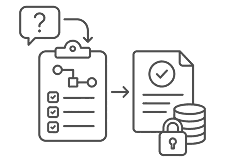
Scope uncertainty in an MVP often means the validation hypothesis isn't clear enough. Our scoping process fixes that before we agree on a price. The scope we commit to is what we build. The budget doesn't change due to a vague initial brief.
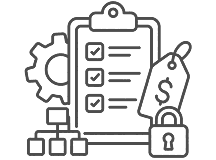
An MVP that launches without structured learning is just a small product release, not lean product development. To ensure actionable insight, we define metrics before the build. We instrument the MVP to capture them and deliver a validation report with the product.
Core technical choices for the MVP, including how data will be stored and organized (data structure), how the system's components are arranged and function together (system organization), how different parts connect and communicate (integration design), and architectural decisions that will be adopted by the full product.
MVP software development that delays architecture decisions produces a validation artefact that has to be rebuilt before the full product can begin. This document ensures early, deliberate decisions for the full product.
The MVP extends into the full build rather than preceding a rebuild, which means the validation investment compounds rather than gets written off.
Eliminates the technical debt that accumulates when an MVP is built without considering what comes after it.
A fully functional, tested product, web, mobile, SaaS, API-first, or AI-powered, instrumented to capture needed behavioral data.
The MVP validates. It must work reliably under real use, producing data that reflects real interactions with the core proposition.
Real users interact with a working product, so validation data reflects true behavior rather than tolerance for a faulty prototype.
QA under real usage finds issues threatening validation data before users encounter them.
Documentation showing what MVP data revealed, assumptions confirmed or changed, and what the full build should reflect, structured as a brief for the development team.
An MVP that launches and produces no structured learning is just a small product. The validation report is what turns user behaviour into build decisions — and what justifies the full development investment to stakeholders who weren't in the room when the hypothesis was defined.
The full build starts from validated assumptions rather than the original conviction, which is the difference between a product built on evidence and one built on hope.
Prevents the full build from inheriting assumptions that the MVP was meant to test.