
AI Implementation Services: How Businesses Turn Artificial Intelligence Into Real Business Value
Every organization today is exploring Artificial Intelligence.
Some businesses are using AI tools to improve productivity. Others are experimenting with automation, generative AI, and intelligent assistants.
But there is a major difference between using AI and implementing AI successfully across business operations.
A company can purchase an AI tool within minutes.
The difficult part is making AI work with:
- Existing business processes
- Internal systems
- Company data
- Employee workflows
- Customer interactions
Many AI initiatives fail because businesses start with technology instead of understanding the problem they want to solve.
The organizations creating real value from AI are not simply adopting more tools.
They are building intelligent systems that improve how work gets done.
This is where AI implementation services become important.
The real question is no longer:
"Should our business use AI?"
The real question is:
"Where can AI create measurable improvement, and how do we integrate it successfully?"
What Are AI Implementation Services?

AI implementation services help businesses integrate artificial intelligence into their existing operations, systems, and workflows.
Unlike basic AI adoption, implementation focuses on creating practical solutions around specific business requirements.
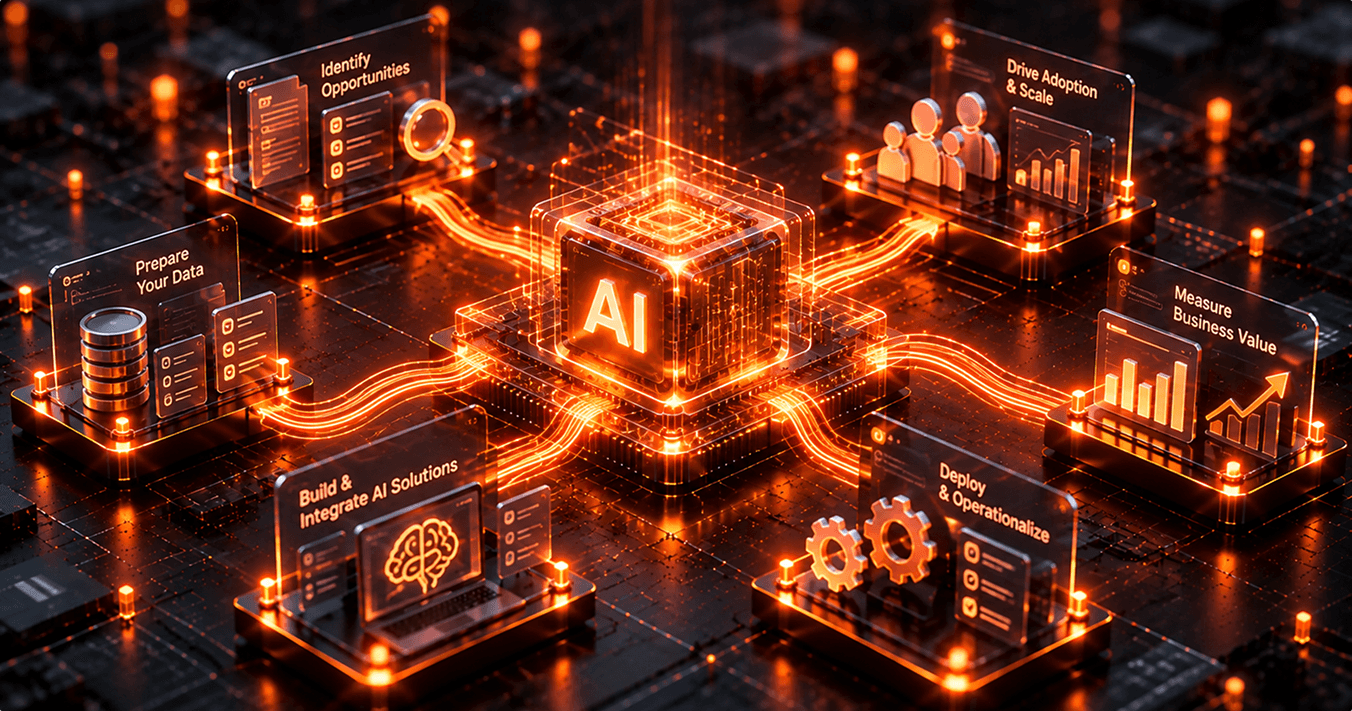
A complete AI implementation process includes:
- Identifying AI opportunities
- Creating an AI implementation strategy
- Preparing business data
- Integrating AI with existing software
- Developing customised AI solutions
- Deploying systems into real environments
- Monitoring and improving performance
At its core, AI implementation connects business goals with AI capabilities.
The Key Components of AI Implementation
| Component | Purpose |
|---|---|
| Business Analysis | Identify problems where AI can create value |
| AI Strategy | Define the right implementation roadmap |
| Data Assessment | Evaluate data quality and availability |
| AI Development | Build solutions around business requirements |
| Integration | Connect AI with existing systems |
| Deployment | Launch AI solutions for real users |
| Optimisation | Continuously improve performance |
AI is not valuable because it is advanced technology.It becomes valuable when it improves business outcomes.
AI implementation creates business value when AI is integrated into existing workflows, systems, and data, not simply added as another tool.
AI Adoption vs AI Implementation: Understanding The Difference
Many businesses use AI tools every day. However, using AI and implementing AI are two different stages.
| AI Adoption | AI Implementation |
|---|---|
| Using available AI tools | Building AI into business workflows |
| Individual productivity improvement | Organisation-wide operational improvement |
| Generic solutions | Business-specific solutions |
| Limited integration | Connected systems |
| Short-term benefits | Long-term capability |
For example:
An employee using AI to summarise documents is AI adoption.
A company building an AI system that analyses documents, extracts information, updates internal software, and triggers workflows is AI implementation.
The difference is not the AI technology.
The difference is how deeply AI becomes part of the business.
Why Businesses Need AI Implementation Services
AI tools have become easier to access.
However, successfully implementing AI inside an organisation remains challenging.
Growing businesses usually face four major challenges.
1. Finding The Right AI Use Cases
The biggest mistake businesses make is asking:
"Where can we add AI?"
Instead, they should ask:
"Which business problems can AI solve?"
The strongest AI opportunities usually exist in processes that are:
- Repetitive
- Time-consuming
- Data-heavy
- Rule-based
Examples:
- Customer support
- Document processing
- Sales operations
- Reporting
- Internal knowledge management
A successful AI implementation starts with business problems, not technology trends.
2. Connecting AI With Existing Systems
Most businesses already have multiple systems:
- CRM platforms
- ERP software
- Databases
- Internal applications
- Business dashboards
The challenge is making AI work with these systems.
Without proper AI integration services, businesses often create another disconnected technology layer.
A valuable AI solution should connect with existing workflows instead of creating additional complexity.
3. Preparing Business Data
AI systems depend on information.
However, many organisations struggle with:
- Data stored across different platforms
- Inconsistent records
- Manual information management
- Limited data accessibility
Before implementing AI, businesses need to understand:
- What data exists?
- Where is it stored?
- How reliable is it?
- How can AI access it securely?
4. Driving Employee Adoption
Technology alone does not create transformation.
Employees need to understand:
Why AI is introduced
How it improves their work
How workflows will change
The most successful AI implementations combine technology with change management.
Identify Where AI Can Create Real Business Impact
Many organisations know AI can improve efficiency but struggle to identify the right starting point.Olio Nexus helps businesses evaluate processes, identify AI opportunities, and create practical implementation roadmaps.
The AI Implementation Process: From Strategy To Deployment
.png)
A successful AI implementation requires a structured approach.
Step 1: Identify Business Opportunities
The first step is understanding where AI can create measurable value. Businesses should analyse:
| Question | Purpose |
|---|---|
| Which tasks consume the most time? | Identify automation opportunities |
| Where do employees perform repetitive work? | Find efficiency gaps |
| Which decisions require better insights? | Identify intelligence opportunities |
| Which processes create delays? | Prioritise improvements |
The goal is to identify processes where AI can create meaningful impact.
Step 2: Build An AI Implementation Strategy
A strong AI implementation strategy defines the roadmap from idea to deployment.
It should include:
Business Objective
What should AI improve?
Examples:
- Reduce manual effort
- Improve customer experience
- Increase operational efficiency
Technology Approach
What solution is required?
Examples:
- AI automation
- Generative AI applications
- AI assistants
- Predictive systems
Success Metrics
How will impact be measured?
Examples:
- Time saved
- Faster processing
- Reduced errors
- Better decision-making
Step 3: Integrate AI With Existing Business Systems
AI creates maximum value when connected with existing operations.
AI integration services help businesses connect AI solutions with:
- CRM systems
- ERP platforms
- Databases
- Internal applications
- Knowledge systems
Examples:
A manufacturing company can integrate AI with operational data to identify inefficiencies.
A financial organisation can use AI with customer data to improve service delivery.
A logistics company can connect AI with tracking systems for better visibility.
Step 4: Develop Custom AI Solutions
Every business has unique processes.
A standard AI tool may not solve specific operational challenges.
Custom AI solutions can include:
AI Knowledge Assistants
Helping employees quickly access information from:
- Documents
- Internal databases
- Company knowledge resources
AI Automation Systems
Reducing repetitive activities such as:
- Data processing
- Approvals
- Reporting
- Information routing
Intelligent Decision Systems
Helping teams analyse:
- Customer behaviour
- Operational trends
- Business performance
Build AI Solutions Around Your Business Processes
Generic AI tools cannot always match unique business requirements. Olio Nexus builds custom AI-powered systems designed around existing workflows, technology environments, and business objectives.
Step 5: AI Deployment And Testing
Deployment is where AI moves from development into real business usage. Before launching, businesses should evaluate:
| Area | Focus |
|---|---|
| Accuracy | Are AI outputs reliable? |
| Security | Is business data protected? |
| Performance | Can systems handle demand? |
| Adoption | Can teams use the solution effectively? |
| Impact | Is the business improving? |
A successful AI deployment services approach ensures the solution works in real-world conditions.
Step 6: Monitor, Improve And Scale
AI implementation is not a one-time project.
Business needs change.
Data grows.
Workflows evolve.
Successful organisations continuously improve AI systems through:
- Performance monitoring
- User feedback
- Workflow optimisation
- New AI opportunities
AI becomes a long-term business capability.
Common AI Implementation Use Cases
Customer Support Automation
AI can help businesses:
- Answer common questions
- Categorise requests
- Route conversations
- Support customer teams
The objective is not replacing people.
It is helping teams focus on complex customer interactions.
Document Processing
Businesses manage thousands of documents:
- Invoices
- Contracts
- Reports
- Forms
AI can help:
- Extract information
- Classify documents
- Reduce manual processing
- Improve accuracy
Sales Intelligence
AI can support sales teams through:
- Lead qualification
- Customer analysis
- Conversation summaries
- Opportunity identification
Internal Knowledge Systems
Growing organisations often struggle to find information across:
- Emails
- Documents
- Applications
- Databases
AI-powered knowledge systems help employees access accurate information faster.
Common Mistakes Businesses Make During AI Implementation

Implementing AI Without Clear Objectives
AI should solve a business challenge.
Starting with technology often leads to unclear outcomes.
Automating Broken Processes
AI can improve workflows.
But it cannot fix poorly designed processes.
Automating inefficient processes simply makes inefficiency happen faster.
Ignoring Data Quality
AI depends on reliable information.
Poor data creates poor results.
Treating AI As A One-Time Project
Successful AI requires continuous improvement.
Businesses need to monitor, optimise, and expand AI capabilities over time.
Before implementing AI, define a measurable business goal, fix inefficient workflows, validate data quality, and plan for continuous monitoring and optimisation.
How Businesses Measure AI Implementation ROI
AI success should be measured through business outcomes.
| Measurement Area | Example Impact |
|---|---|
| Productivity | Reduced manual work |
| Speed | Faster processes |
| Accuracy | Fewer errors |
| Cost Efficiency | Reduced operational costs |
| Customer Experience | Faster responses |
The goal is not implementing AI. The goal is improving business performance.
Choosing The Right AI Implementation Company
A successful AI implementation requires more than technical expertise.
The right AI implementation company should understand:
Business Processes
AI should solve real operational challenges.
Technology Integration
AI should connect with existing systems.
Scalability
Solutions should support future growth.
Business Outcomes
Success should be measured through measurable improvements.
The Future Of AI Implementation

AI implementation is moving beyond individual tools.
Businesses are increasingly adopting:
- AI-powered workflows
- Intelligent automation
- AI agents
- Predictive systems
- Autonomous decision support
However, the businesses that benefit most will not be those using the most AI tools.
They will be those implementing AI where it creates meaningful business value.
Final Thoughts
Every business wants to:
- Improve efficiency
- Reduce operational complexity
- Deliver better customer experiences
- Make faster decisions
But technology alone does not create transformation.
The real advantage comes when technology is designed around the way a business operates.
AI implementation is not about adding another tool.
It is about creating intelligent systems that help businesses work better, scale faster, and make smarter decisions.
Share This Blog:



Author
Siddesh Bharat Mane

Founder & Director, Olio Nexus
Siddesh Bharat Mane, Founder and Director of Olio NeXus, brings insights from over 500 digital and technology projects. He is passionate about helping businesses harness technology to set the pace in their industries. His writing explores AI, emerging tech, and bold strategies that help innovators accelerate growth and get light years ahead of competitors.
Frequently Asked Questions
AI implementation services help businesses integrate artificial intelligence into existing workflows, systems, and operations to solve specific business challenges.
Related Articles


Subscribe To Our Insight
Get the latest AI, technology, and business insights from Olio Nexus.