
Technology Roadmap for Businesses: Plan, Execute & Scale in 2026–27
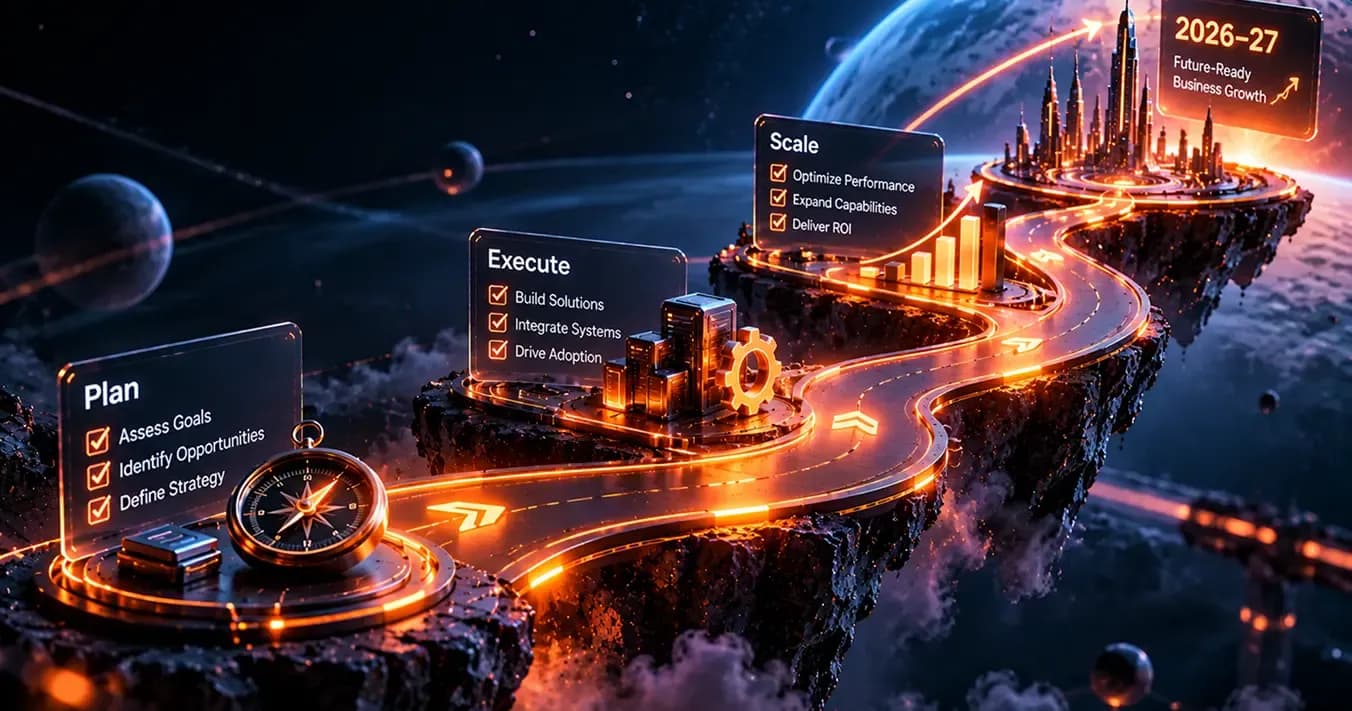
A business planning to scale in 2026–27 might need to replace a legacy application, connect its CRM with its ERP, automate reporting and explore AI for routine operational tasks. Each initiative makes sense on its own.
The challenge is deciding what to prioritise, what depends on other projects and how much to invest without disrupting day-to-day operations.
Without a clear plan, businesses risk spending on new systems while existing integration issues, manual workflows and technical limitations continue to hold them back.
A technology roadmap connects these decisions to business goals. It sets out which capabilities the business needs, what should happen first and how each investment will support the next stage of growth.
What Is a Technology Roadmap?

A technology roadmap is a plan that shows how a business will develop its technology capabilities over a defined period to support its operational and strategic goals.
It typically covers:
- Business objectives: The outcomes technology needs to support.
- Current systems: Existing applications, infrastructure, integrations and technical limitations.
- Technology priorities: The changes that will deliver the greatest business value.
- Implementation sequence: The order of projects, including dependencies between them.
- Resources and investment: Budget, internal capabilities, external expertise and implementation effort.
- Success measures: How the business will evaluate whether each initiative has delivered its intended result.
A useful roadmap also distinguishes between urgent operational fixes and longer-term investments.
For example, replacing an unreliable integration may need to happen before introducing an AI agent that depends on the data flowing through it.
Similarly, a business may need to standardise its reporting process before investing in cutting-edge analytics.
The roadmap makes these relationships visible before individual projects start competing for budget and attention.
The scale of technology investment makes prioritisation increasingly important. Gartner forecasts worldwide IT spending will reach US$6.37 trillion in 2026, up 14.2% from 2025.
For individual businesses, the challenge is deciding which investments will solve real operational problems, which capabilities need to come first and where spending is unlikely to deliver sufficient value.
Technology Roadmap Planning
Build a clear technology roadmap that aligns business goals, prioritises investments, and guides technology decisions from planning to implementation.
Why Businesses Need a Technology Roadmap for 2026–27
Technology planning becomes difficult when decisions are made independently. A new application might solve one team’s problem while creating another integration requirement.
An AI initiative might look promising but depend on data the business can't reliably access.
A roadmap helps deal with these matters before they become expensive implementation problems.
1. Connect Technology Spending to Business Priorities
Every significant technology investment should have a business reason behind it.
That might be cutting processing time, improving customer response, increasing production capacity, strengthening data security or supporting expansion into new markets.
Without this connection, IT budgets can become a collection of requests rather than a coordinated investment plan.
Business technology planning helps leaders compare initiatives based on their expected contribution to business goals, implementation cost, risk and time to value.
2. Identify Dependencies Before They Delay Projects
Technology projects rarely operate in isolation.
A new customer platform may depend on clean customer data. Reporting automation may require consistent inputs from multiple systems. An AI agent may need reliable access to business information and a defined process for dealing with exceptions.
If these dependencies are discovered during implementation, deadlines and expenses can quickly change.
A roadmap identifies the fundamental work that needs to happen first, helping teams sequence projects more realistically.
3. Make Better Decisions About AI and Automation
AI and automation can improve how businesses handle repetitive work, retrieve information and process requests. However, not every workflow needs a new AI solution.
Some problems are better addressed through conventional software, system integration or process redesign.
A technology roadmap gives decision-makers a way to evaluate these options against the actual business requirement. It also helps identify where data quality, security, integration or workflow changes must be addressed before deployment.
4. Support Growth Without Adding Unnecessary Complexity
Systems that work for a small operation may struggle as transaction volumes, teams, locations or customer requirements increase.
A roadmap helps identify where existing technology can continue to serve the business, where it needs improvement and where replacement is justified.
This prevents growth from becoming an ongoing cycle of rushed purchases, temporary workarounds and expensive system changes.
Is Your Technology Plan Focused on the Right Priorities?
Identify which systems, processes and investments need attention before committing more budget to technology.
How to Build a Technology Roadmap

The process should begin with the business, not with a preferred technology or a list of products to implement.
Step 1: Define the Business Goals
Start by identifying what the organisation needs to achieve over the next 12 to 24 months.
Examples include:
- Lowering manual effort in main operations
- Improving visibility across departments
- Shortening order processing or service response times
- Integrating fragmented business systems
- Supporting higher transaction volumes
- Improving security and reducing technical risk
Make the outcomes specific enough to guide decisions.
If the goal is to reduce processing time, establish the current baseline and the improvement the business wants to achieve. This gives technology initiatives a measurable purpose.
Step 2: Assess the Current Technology Environment
Before deciding what to build, buy or replace, understand what the business already has.
Review existing applications, infrastructure, integrations, data flows, security requirements and recurring operational issues. Speak with the people who use these systems, because documented processes do not always reflect what happens in practice.
Look for duplicated functionality, manual data transfers, unsupported systems, unreliable integrations and applications that no longer meet business needs.
The aim is to identify which limitations are holding the business back and which existing capabilities can be retained.
Step 3: Prioritise Initiatives by Business Value
Not every problem needs to become an immediate project.
Evaluate proposed initiatives against a consistent set of criteria:
- Expected business impact
- Implementation cost and effort
- Operational risk
- Dependencies on other projects
- Time required to deliver value
- Ability to scale as requirements change
A project with a modest scope may deserve priority if it removes a bottleneck affecting several departments. A more aspiring initiative may need to wait until its data, integration or infrastructure requirements are addressed.
This is where an IT strategy roadmap becomes useful. It translates business priorities into a sequence of technology decisions rather than treating every request as equally urgent.
Step 4: Sequence the Work
Once priorities are clear, organise them into a realistic delivery plan. A simple structure for 2026–27 could look like this:
| Timeline | Focus | Typical initiatives |
|---|---|---|
| Near term | Fix immediate constraints | Resolve integration failures, address security gaps, standardise critical data |
| Medium term | Build operational capability | Modernise applications, automate suitable workflows, connect core systems |
| Longer term | Scale proven improvements | Expand successful automation, improve analytics, extend AI capabilities where justified |
This is an illustrative structure, not a fixed schedule. Actual timing depends on the organisation’s priorities, resources, technical dependencies and risk tolerance.
The important part is sequencing. Core work should support the initiatives that depend on it, while early projects should deliver useful results without creating problems for later phases.
Step 5: Assign Ownership, Budget and Success Measures
A roadmap needs clear accountability to move beyond planning.
Each initiative should have an owner, an approved budget, a delivery timeframe and a way to measure its results. Responsibilities should be clear across business, operations and technology teams.
For example, an automation project should not be measured only by whether the software was deployed. The business should also track whether manual handling decreased, processing became faster or error rates improved.
These measures make it easier to assess progress and decide whether an initiative should be expanded, adjusted or stopped.
Step 6: Review and Update the Roadmap
A technology roadmap should guide decisions without becoming rigid.
Business priorities change. New requirements emerge. Projects reveal dependencies that were not visible during planning. A solution that looked promising during evaluation may not deliver the expected result once tested in a real workflow.
Review the roadmap regularly, assess progress against business outcomes and modify priorities when the evidence supports a change.
The aim is to maintain direction while giving the business enough flexibility to respond to what it learns.
Where Technology Roadmap Planning Needs Expert Support
Some organisations can manage individual technology upgrades internally. More complex environments need a broader view of how systems, workflows, data and business priorities connect.
Technology roadmap planning can help when an organisation is dealing with legacy applications, fragmented systems, competing investment requests or uncertainty about where AI and automation will deliver value.
At Olio Nexus, we approach technology decisions by first understanding the operational problem and the context in which the solution must work. Depending on the requirement, the roadmap may call for software development, system integration, application modernisation, automation or AI.
The right combination depends on what the business needs to improve, what it already has and what it needs to support next.
Connected Technology Ecosystem
Aligning software, systems, data, and business priorities to build a scalable technology foundation that supports long-term growth.
Turn Your Technology Roadmap Into Measurable Progress

A useful roadmap gives the business a clear reason for each investment, a sensible order for implementation and a way to judge whether the work is paying off.
For 2026–27, the priority is to make technology decisions that solve current operational problems while preparing the organisation for its next stage of growth.
Olio Nexus helps businesses connect strategy with execution, building and integrating technology around the way their operations actually work.
Share This Blog:



Author
Siddesh Bharat Mane

Founder & Director, Olio Nexus
Siddesh Bharat Mane, Founder and Director of Olio NeXus, brings insights from over 500 digital and technology projects. He is passionate about helping businesses harness technology to set the pace in their industries. His writing explores AI, emerging tech, and bold strategies that help innovators accelerate growth and get light years ahead of competitors.
Need Clarity on Your Technology Priorities?
Share the challenges you’re working through, and we’ll help identify which technology decisions deserve attention first.
Frequently Asked Questions
A business technology roadmap should connect business goals with existing systems, planned investments, project dependencies, implementation timelines, resource requirements and success measures. It should also identify which initiatives need to happen first and how progress will be reviewed.
Related Articles



Subscribe To Our Insight
Get the latest AI, technology, and business insights from Olio Nexus.