Loading service0%
Build software that fits the way your business actually runs.
We provide end-to-end AI-integrated software development, covering discovery, architecture, development, and QA. Through agile sprints, we ensure you receive a production-ready product at every stage, built with AI-native software product development principles from day one.
In 3-6 months, you'll have: A fully built, tested, and deployed software product owned entirely by you, documented, maintainable, and ready to scale as your business does.
A fully built, tested, and deployed software product owned entirely by you.
The brief was clear. The timeline looked reasonable. Three months in, what's being built doesn't match what was needed. Features that seemed straightforward are taking four times as long. The budget is moving, and the delivery date isn't.
Requirements were treated as a document, not a conversation. The gap between what a client writes in a brief and what they actually need only shows up once development is underway, when changing direction is already expensive. Custom software development that skips that conversation builds the wrong thing correctly.
You've worked with a software development company before. What was delivered worked in isolation but didn't connect to anything else your business runs on. The handover was thin. Now your team is managing software nobody fully understands.
The build was scoped as a feature list, not a product. Features get built to specifications. But products get designed with architecture that accounts for how the software grows, what it connects to, and who maintains it after the agency leaves. One produces a deliverable. The other produces something your business can run on.
Good software development services start with the product problem, not the feature list. Before architecture is designed or a sprint is planned, we need to understand what the software has to do for the business, and not just what it has to do technically. These fundamentals shape every AI-native software product development engagement:
The requirement document is just the tip of understanding the problem you're trying to solve or the opportunity you want to seize. But discovery conversations tell us what you actually need: the workflows the software has to support, the situations the brief didn't account for, and the integrations that determine whether the product works in a real environment or just in isolation.
Good software development services start with the product problem, not the feature list. Before architecture is designed or a sprint is planned, we need to understand what the software has to do for the business, and not just what it has to do technically. These fundamentals shape every AI-native software product development engagement:
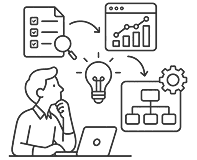
Development without analysis will result in building the wrong product correctly. Our business analyst doesn't just see the software requirement as a formality of custom software development. At NeXus Build, we analyze the requirements from all angles, weighing the cost-benefits of all possible solutions. We take the workflows, constraints, integrations, and edge cases (unexpected situations) into account.
Every custom software development engagement follows the same discipline from discovery to deployment:
Full documentation of product requirements, including workflows, user journeys, integration dependencies, edge cases, and acceptance criteria for every feature.
The most common reason custom software development projects go over budget is that requirements shift mid-build because they weren't fully defined at the start. This document is what every subsequent decision gets measured against.
Development runs against confirmed requirements, not the assumptions, revised sprint by sprint.
Scope changes surface before they affect the build, when they're still cheap to address.
Discovery complete. Requirements defined and signed off. Architecture agreed. First sprint underway with working functionality in review.
Core functionality built and tested across multiple sprints. Integration points confirmed stable. UAT underway with real users against real requirements.
The full product goes live in production. Team operating and maintaining it independently. First iteration scoped from what real usage showed.
What you're running was built for the business you had. It doesn't fit the one you have now, and patching it costs more than replacing it. You need custom software development scoped around how your operation actually works today.
You know what the product needs to do. You don't have the architecture, development, or QA capability in-house to build it properly. You need a software development company that treats your product problem as seriously as you do.
Standard platforms handle standard workflows. Yours aren't standard. Product engineering services (done faster with AI) built around your specific operational requirements, your data model, your integrations, and your compliance constraints produce software that fits how your business actually runs.
We build healthcare technology solutions powered by AI to improve patient experiences and streamline care delivery and operational workflows.
We build real estate technology solutions powered by AI to accelerate lead conversion, streamline property operations, and enhance buyer and tenant experiences.
We build interactive learning apps and management systems powered by AI and data technology solutions to improve learner engagement and scale digital learning ecosystems.
We build engineering software solutions that accelerate product development, enhance R&D collaboration, and connect your product, business, and support systems using AI, IoT, and modern data platforms.
We create smart manufacturing technology solutions that provide a real-time perspective in both sales and production, supported by IoT, AI, and data technologies.
A mid-size logistics company was running fleet and shipment operations on an internal platform built eight years earlier and patched continuously since. Three developers had each left without documenting their changes. The platform worked (until it didn't), and nobody could reliably predict which change would break what.
The rebuild took fourteen weeks from discovery to deployment. The new platform handles the same operational load with a codebase that the current team can maintain. Three downstream problems in finance and customer communication were resolved as a consequence of the cleaner architecture. Eight years of technical debt were cleared in a project that cost less than two of the previous year's patch cycles.
We built the four core functions as a new AI-integrated software platform, connected the rest to existing tools through clean integrations, and migrated data over a structured transition period.
We'll work through the requirements with you, define what actually needs to be built, and tell you what the scope involves before any commitment is made.
App development typically refers to building a front-end interface. AI-integrated Software product development covers the full product: architecture, backend systems, integrations, deployment infrastructure, and documentation. An app is one layer. A software product is everything that makes it work and maintainable.
Documented, maintainable, and ready to scale as your business does.
A production-ready product at every stage of development.
The brief was clear. The timeline looked reasonable. Three months in, what's being built doesn't match what was needed. Features that seemed straightforward are taking four times as long. The budget is moving, and the delivery date isn't.
You've worked with a software development company before. What was delivered worked in isolation but didn't connect to anything else your business runs on. The handover was thin. Now your team is managing software nobody fully understands.
Requirements were treated as a document, not a conversation. The gap between what a client writes in a brief and what they actually need only shows up once development is underway, when changing direction is already expensive. Custom software development that skips that conversation builds the wrong thing correctly.
The build was scoped as a feature list, not a product. Features get built to specifications. But products get designed with architecture that accounts for how the software grows, what it connects to, and who maintains it after the agency leaves. One produces a deliverable. The other produces something your business can run on.
The consequences? Software is delivered but doesn't get used, or gets harder and more expensive to keep running with every passing month.
Or worse: A product built exactly to specifications, for requirements that were already wrong by the time development finished.
How software is structured affects how fast it can change, how much it costs to maintain, and whether it scales without a rebuild. Our AI product engineering services treat architecture as something the client understands and signs off on, and not something decided in the background by developers alone.
Every sprint ends with working functionality reviewed against real requirements. Problems surface at the sprint level, where they cost hours to fix, not at delivery, where they cost months. AI-assisted Software development services built in sprints mean feedback is continuous.
Code, architecture, documentation, and IP, all yours. No proprietary frameworks that lock you into our stack. No vendor dependency is built into the product. What we build is fully documented and transferable from the moment it's delivered.
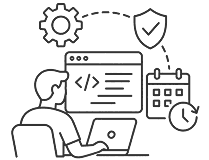
Every architecture decision accounts for who owns the product after handover, what skill level they have, what changes they'll need, and what technical debt costs them if we cut corners now. An AI software development company that optimises for delivery speed at the cost of maintainability hands over a product with a built-in expiry date.
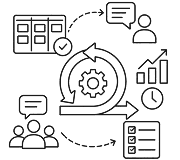
Every sprint produces working functionality reviewed against confirmed requirements. Feedback at the sprint level costs hours. Feedback at the delivery level costs months. That's why our product engineering services surface problems early, while they're still cheap to fix.
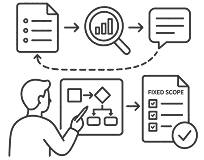
Scope changes happen when requirements aren't defined properly at the start. Our discovery process closes that gap before development begins. As a result, the scope we agree on is the scope on which we build the solution.
The technical blueprint for the product, including structure, infrastructure, integration design, data models, and decisions that affect how the software scales and gets maintained over time.
Architecture decided without business input produces software that works technically but doesn't fit operationally. This document makes those decisions visible before a line of code is written.
Fewer surprises mid-development. A product that fits the environment it runs in.
Architectural problems caught in design cost days to fix. In development, they cost weeks. After launch, months.
Functional software is delivered in regular sprints, reviewed against acceptance criteria, and iterated on before the next sprint begins.
A three-month build with a single review at the end is a three-month window for requirements to drift from reality. Sprint-based and AI-powered software development services surface that drift early, when correcting it is still manageable.
Stakeholders see working software throughout the build, not progress reports.
Problems that would have caused a delivery failure get caught at the sprint level, before they derail the timeline.
A fully tested product is deployed to your environment, fully functional. Integration, performance, and user acceptance testing completed against real usage conditions before go-live, with CI/CD pipeline configured for ongoing deployments.
Software that passes development testing and fails in production does so because production conditions weren't part of the test scope.
What launches have been confirmed to work under the conditions your users actually create.
Post-launch failures caused by untested integration or performance scenarios get caught before they reach users.
Complete documentation of the codebase, architecture, integration logic, deployment configuration, and maintenance procedures, written for the team that owns the product after handover.
Software your team can't maintain without calling us isn't fully delivered. Documentation is what makes the handover real.
Full operational ownership from day one. No dependency on the development team for routine changes.
Prevents gradual degradation when software goes unmaintained because the inheriting team doesn't understand how it was built.