
Change Management in Digital Transformation: Challenges & Solutions
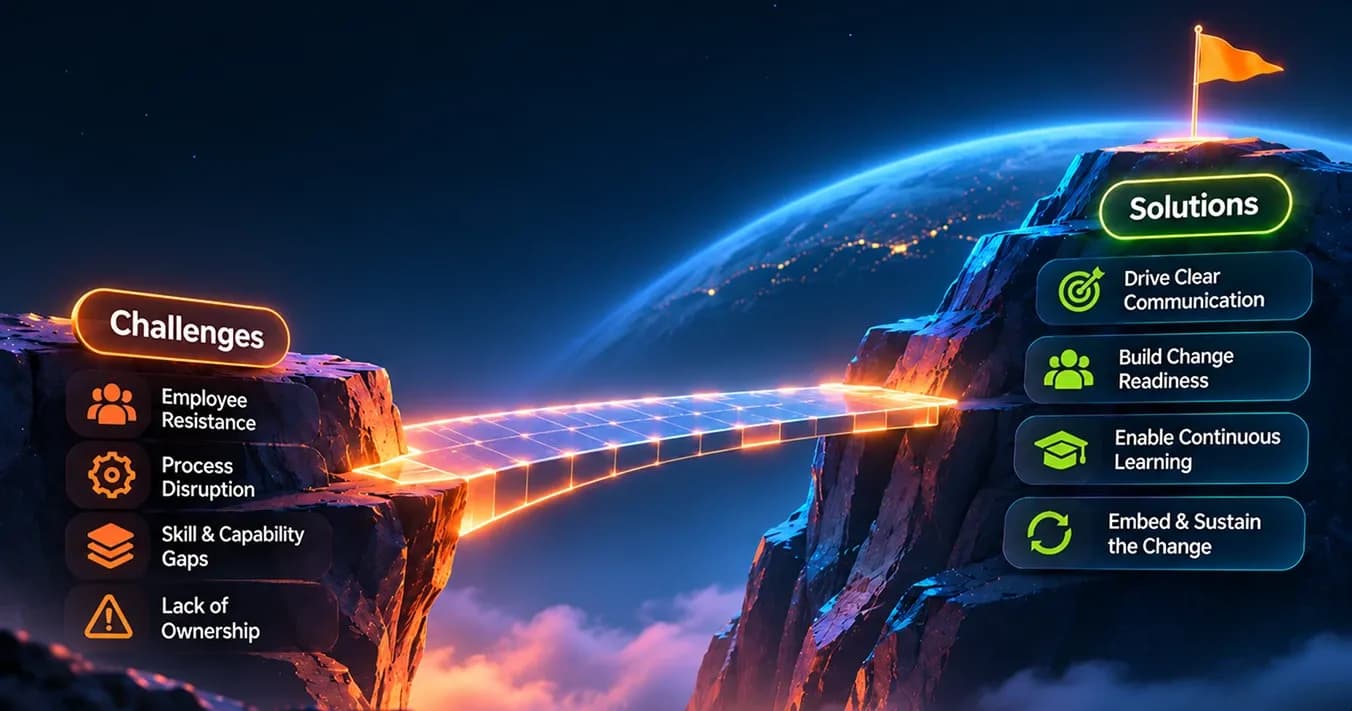
Even if a digital transformation works from a technical standpoint, it might not actually help the business improve.
The new ERP system is up and running, but teams still rely on spreadsheets. Even when an automation system works as planned, employees may find workarounds if the new process does not match how they really work.
The organisation spends money on technology, implementation, and infrastructure, but the expected improvements in operations do not always happen.
This is why change management is so important in digital transformation. Technology can update the system, but the business also needs to change how work is done.
What Change Management Means in Digital Transformation
Change management is a step-by-step way to help an organisation shift from its current way of working to a new one.
In a digital transformation, that can involve:
- Process redesign
- Stakeholder alignment
- Changes to roles and responsibilities
- Communication and training
- Digital adoption
- Leadership involvement
- Post-implementation support
- Measuring behavioural and business outcomes
The goal is not just to get employees to use a new app. It is to make the new way of working practical so people will use it, and effective enough to achieve the business results you want.
This is particularly important when managing change in organizations involves multiple teams, systems and operational processes.
Where Digital Transformation Goes Wrong

Digital transformation brings its own challenges because technology rarely changes just one thing. A new platform can impact processes, responsibilities, information flow, approvals, reporting, and decision-making.
Some problems tend to come up again and again.
Technology Comes Before the Process
Sometimes, a transformation begins with picking a technology rather than focusing on a business problem.
After choosing a platform, teams often try to fit their current processes into it. This can keep old, inefficient workflows in place, just in a new system.
Before rolling out new technology, organisations should understand how work really gets done in the business.
Where does information enter? Who acts on it? Which systems are involved? Where do approvals slow things down? Which tasks are still handled manually?
These answers should help shape the new process and the technology that supports it.
Different Stakeholders See Different Problems
A CEO might care most about scalability. A COO could be looking for better efficiency. An IT leader may focus on integration, security, and system design.
Employees often have a different worry: how will this change affect their daily work?
A good change management plan should bring these different views together. People need to know what is changing, why it matters, and what their role will be after the change.
Training Does Not Fix a Poor Process
Training can show how a system works, but it cannot fix a process that is awkward or does not match how people really work.
So, training should focus on real workflows, roles, and exceptions, not just a list of software features.
Legacy Systems Create Hidden Dependencies
A new platform almost never gets rid of all old dependencies right away.
Older systems might still have important information. Spreadsheets can hold business rules that were never written down. Teams may keep using email if the new app does not handle certain exceptions yet.
If these dependencies are overlooked, employees may have to juggle two ways of working. This adds complexity and can hurt adoption and data quality.
Go-Live Is Not the Same as Success
A project might launch on time but still not deliver the expected business results.
- The most important measures come after the system is in place.
- Are employees finishing the right workflows?
- Has manual work gone down?
- Are there fewer errors? Is information more reliable?
Is the business getting the visibility or capacity it wanted from the transformation?
These are the signs that show if the change is really working.

Digital Transformation Strategy Guide
Navigate digital transformation with a clear strategy that aligns technology, business processes, people, and long-term business objectives.
Building a Change Management Strategy Around the Business

A strong change management strategy links the business goal with the people, processes, and technology needed to reach it.
1. Define the Business Outcome
Start with what needs to improve.
This could be faster processing, better reporting, less admin work, improved customer response, more capacity, or better visibility across the organisation.
A clear goal gives the transformation a concrete target.
2. Map the Operational Impact
Figure out which teams, roles, processes, and systems will be affected.
The same transformation can impact departments in different ways. For example, a new finance platform might change finance a lot but only slightly affect sales.
Understanding those differences early makes the employee adoption strategy more practical.
3. Redesign the Workflow
Do not just copy the old process into the new system.
Cut out unnecessary steps. Make it clear who owns each part. Fix approval delays. Find places where automation can help.
Technology should help create a better process, not keep all the old problems.
4. Prepare People for the New Workflow
Involve employees early, especially those who do the work every day.
Their experience can uncover exceptions and dependencies that documents might miss.
Training can then focus on real situations, and employees will know how to report problems once the new workflow starts.
Digital Adoption Is an Operational Issue
People often think digital adoption is just about training, but training is only one piece.
An employee might know how a system works but still avoid using it if the process is awkward, the information is missing, or the system does not fit how work really happens.
A better adoption approach links together:
Clear process → usable technology → role-specific guidance → support → measurement → continuous improvement
This is especially important in large organisations, where a small workflow problem can impact hundreds of employees or create issues across many departments.
Make Your Transformation Easier to Adopt
Share what you’re changing, and we’ll help you identify the process or technology gaps that could affect adoption.
A Manufacturing Transformation That Started With the Process
A manufacturing transformation shows why this is important.
A mid-sized manufacturer wanted to automate production reporting and first thought that data collection was the main problem.
But the assessment found something else.
Each operations manager spent about 2.5 hours a week gathering data, but another 11.5 hours went into putting reports together and formatting them. Reports had to be rebuilt every time, there was no shared data model, and spreadsheet formats were different for each user.
They redesigned the reporting data model and standardised the inputs before adding AI. Then, an AI tool was built to create draft management reports from these structured inputs.
The results were impressive. Report compilation dropped from 11.5 hours to less than 45 minutes per manager each week. Reviews went from every two weeks to weekly, and the same team handled 40% more production.
The technology added value because the process was improved first to make it work well.
Measure the Change, Not the Deployment
You need to measure a transformation at three levels.
Adoption
Are people using the new system and completing the required workflows?
Behaviour
Have teams actually changed how work is performed?
Business Impact
Is the organisation achieving the outcome that justified the transformation?
For example:
Workflow automation → fewer manual steps → shorter processing time → greater operational capacity
Or:
New CRM → higher usage → more complete customer records → better sales visibility
This difference is important because high system usage does not always mean the transformation worked. Employees might log into a new platform but still use spreadsheets for key tasks.
The same measurement should continue after implementation. Early usage data, employee feedback and operational results can reveal edge cases or workflow problems that were not visible during planning.
This turns technology adoption into a continuous improvement process, not just a one-time launch.
Where Digital Transformation Consulting Adds Value

For complex projects, digital transformation consulting should link business goals, process redesign, technology choices, and adoption, instead of treating them as separate tasks.
That may involve a new platform, system integration, software development, automation or AI. In some cases, improving an existing system may be the better answer.
Transformation support is valuable because it helps find the right solution for the problem, especially when dealing with old systems, broken workflows, or many business functions.
A good transformation strategy should first figure out what needs to change, then decide how technology can help.
Make Technology Work for the Organisation
Transformation is not finished when the software launches. It is finished when the new way of working delivers the results you want.
At Olio Nexus, we begin by looking at the operational problem, learning how work is really done, and finding where software, integration, automation, or AI can make a real difference. This approach means we always understand the context and goals before building technology. About-Olio-Nexus
Technology is valuable when it fits the organisation, improves workflows, and delivers results the business can measure.
Share This Blog:



Author
Vanita Gaware

Product Manager, Olio Nexus
Vanita Gaware, Product Manager at Olio NeXus, champions the idea that every great product starts with asking the right questions. She thrives where business goals, user journeys, and technology meet, turning complexity into clarity. She writes about AI, software, product strategy, and the choices that turn technology into real-world value.
Get Clarity on Your Transformation
Share your current challenge, and we’ll help you understand what needs attention before you invest further in technology.
Frequently Asked Questions
A change management strategy should cover the business outcome, operational impact, stakeholder involvement, process changes, employee preparation, adoption support and measures for determining whether the transformation is delivering its intended results.
Related Articles



Subscribe To Our Insight
Get the latest AI, technology, and business insights from Olio Nexus.